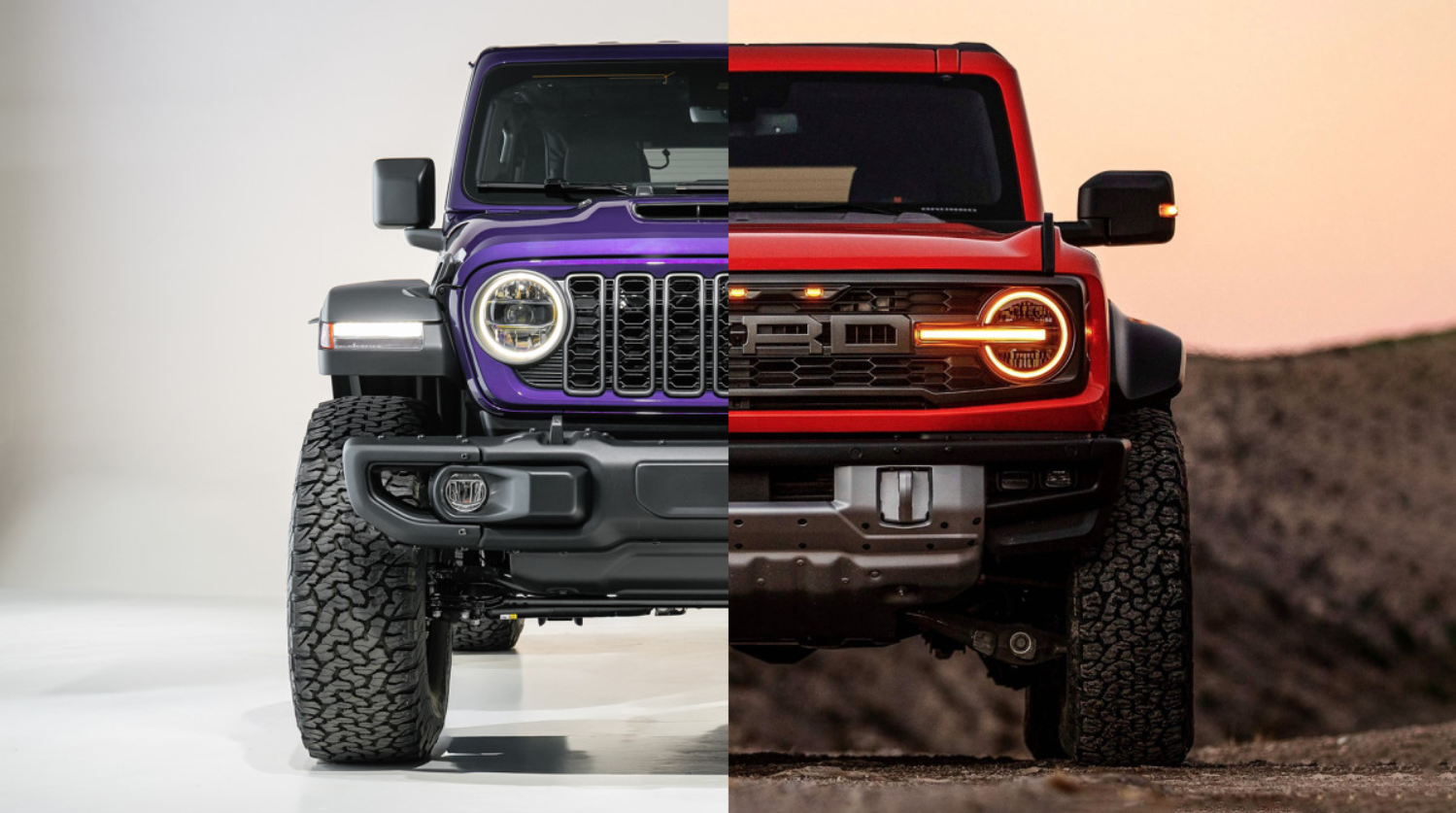
To celebrate its 85th anniversary, Jeep launched the “Twelve 4 Twelve” program, releasing one new special edition Wrangler each month. The first blast was the Jeep Wrangler Moab 392, a four-wheel-drive SUV with a 6.4-liter HEMI V8 under the hood. Unexpectedly, the 2026 Ford Bronco Raptor, a turbocharged beast born on rally-raid tracks, appeared at the starting line beside it. Bronco and Wrangler represent different philosophies but have competed for a long time in the U.S. market.
Heart and Mind: Two Approaches to Power
The Wrangler Moab 392 is a classic off-roader, instantly recognizable. It boasts unique details like Black Beadlock wheels, a MOAB badge on the fender, and a hood with a functional air scoop. The Indy Auto Man experts in used cars in Indianapolis note that this Jeep has a legendary heart: a 6.4-liter naturally aspirated HEMI V8. This engine produces 470 horsepower and 465 lb-ft of torque, making it the most powerful in its class. This Jeep rockets from 0-60 mph in just 4.5 seconds, and its engine sound isn’t noise but music – a symphony of old-school muscle that seemed destined to vanish.
The Ford Bronco Raptor is more like a stormtrooper from the future. It takes a streamlined approach. Its power comes from a 3.0-liter twin-turbo V6. The output is 418 horsepower and about 400 lb-ft of torque, delivered to all four wheels via a ten-speed automatic transmission. Although it’s 0.7 seconds slower to 60 mph, the Raptor has a practical advantage—it can tow up to 4,000 pounds, compared to the Jeep’s 3,000 pounds.
Numbers and Angles: Who’s Better on Paper?
When conquering off-road terrain, body geometry matters. The Ford Bronco Raptor shows impressive off-road skills, thanks largely to its standard 37-inch tires, giving it a phenomenal 13.1 inches of ground clearance. Its approach, departure, and breakover angles are 47.2°, 30.8°, and 40.5°, respectively. It can ford water up to 37 inches deep.
The Jeep Wrangler Moab 392, with 35-inch tires and 11.1 inches of ground clearance, trails only slightly. Its angles are a bit more modest: 46.7° approach, 24.5° departure, and 39.8° breakover. It can handle water up to 34 inches deep. The key difference lies in the suspension design: the Wrangler sticks with solid axles, while the Bronco Raptor uses independent front suspension for a smoother ride at high speeds on rough terrain. However, the Jeep Moab 392 features Jeep’s Selec-Trac all-wheel drive system with low-range gearing, delivering exceptional traction on tough trails.
The Bronco Raptor follows another philosophy. Functionality comes first. It offers hose-washable floors with drain holes, vinyl upholstery, and removable doors and roof in minutes. This vehicle is for those who don’t mind a messy interior. The Bronco Raptor offers up to seven driving modes via Ford’s G.O.A.T. (Goes Over Any Type of Terrain) system, which adapts the vehicle to various surfaces.
It’s somewhat ironic that in this era of total electrification, two such thirsty SUVs are hitting the market in 2026. The Jeep Wrangler Moab 392 gets about 18 mpg on the highway and nearly 15 mpg in the city, while the Bronco Raptor is slightly more efficient—16 mpg city and 20 mpg highway. Still, buyers willing to spend over $80,000 on a special SUV likely don’t sweat fuel costs.
Choosing between the Jeep Wrangler Moab 392 and the Ford Bronco Raptor is a choice between heart and mind, passion and pragmatism. Jeep is a living legend, with a roaring V8 and an 85-year legacy. Its trump card is undeniable charisma and a time-tested design. Ford offers a high-tech, pragmatic take on extreme off-roading, with outstanding geometry and modern electronic aids. Both are spectacular in their own right, proving the era of true SUVs isn’t over. The truth lies somewhere in between, where legend and progress meet.